The Rise of the Regional Innovator
For decades, ambition in Britain followed a familiar map.
If you wanted to build a technology company, scale a creative business, attract investment or surround yourself with opportunity, there was an assumption that eventually you would need to move closer to London. The capital became both destination and default. Talent flowed inward. Businesses clustered tighter. Opportunity appeared concentrated within a relatively small geographic radius.
But something has changed.
Quietly at first, then rapidly, a different kind of business geography began to emerge across the UK. Founders started questioning the trade-off between cost and quality of life. Creative businesses realised they could collaborate remotely while remaining physically rooted elsewhere. Technology firms discovered talent no longer wanted to organise their entire lives around expensive city-centre commuting. Life sciences and innovation-led businesses began seeking environments that encouraged collaboration between sectors, researchers and commercial enterprise rather than simply proximity to financial districts.
Businesses that once accepted rising costs, shrinking space and increasingly transactional work environments started asking a more direct question.
What are we actually getting in return?
Increasingly, the answer has become less convincing.
Across Britain, regional towns and cities are now producing a new generation of ambitious businesses proving innovation no longer belongs exclusively to major metropolitan centres. Technology companies, digital studios, life sciences businesses, sustainability ventures, educators and creative startups are growing in places once overlooked by the national conversation. Not because they failed to reach somewhere else, but because they deliberately chose a different model entirely.
This shift is changing not only where businesses work, but how they work.
And places like Carriage Works are becoming part of that wider story.
A Different Definition of Growth
For years, business success was closely tied to visibility. Bigger city. Bigger office. Bigger postcode.
But modern businesses increasingly operate differently. Collaboration is distributed. Meetings happen digitally. Recruitment reaches nationally. Clients are often spread across multiple regions or countries from day one. Physical presence still matters, but not in the same way it once did.
Instead, businesses are prioritising environments that support sustainable growth rather than performative growth.
That means access to talent without impossible living costs. Space to think. Room to expand. Better work-life balance. Strong infrastructure. Character. Community. Connectivity.
In many ways, regional business hubs now offer advantages larger cities increasingly struggle to provide.
While some metropolitan centres became denser, more expensive and operationally exhausting, many regional locations became more agile. More adaptable. More human in scale.
For ambitious businesses, particularly across technology, digital, creative and life sciences sectors, that matters enormously.
Because innovation rarely thrives under pressure alone. It requires headspace. It requires flexibility. It requires environments capable of supporting both focused work and collaborative thinking.
The rise of the regional innovator is not about lowering ambition.
It is about redefining the conditions in which ambition can flourish.
The New Geography of Talent
One of the biggest misconceptions in British business is that talent only exists in major cities.
It never did.
What large cities historically possessed was concentration, not exclusivity. Universities, infrastructure and established industries created density. But hybrid working, remote collaboration and changing lifestyle priorities have decentralised that advantage.
Now, talented people are increasingly choosing where they want to live first, and where they work second.
That distinction matters enormously.
Quality of life has become a serious economic factor. People want shorter commutes. More affordable housing. Access to green space. Strong communities. Better balance between work and personal life. They want meaningful careers without sacrificing everything around them.
Businesses that understand this are adapting quickly.
Rather than forcing talent toward increasingly expensive urban centres, they are building ecosystems closer to where talented people already want to be.
Alongside creative and digital industries, sectors such as life sciences and applied research are also seeking environments that encourage interdisciplinary collaboration. Businesses operating in these fields increasingly benefit from proximity to universities, specialist talent, research networks and innovation ecosystems rather than purely financial districts or corporate office clusters.
Swindon sits within that wider shift.
Positioned along the M4 corridor and connected to cities including Bristol, Oxford, Reading and London, it occupies a strategic location that increasingly makes sense for modern businesses. Accessible enough to remain connected nationally, but removed from many of the pressures dominating larger urban centres.
But infrastructure alone is not enough.
Businesses also need identity. Atmosphere. Momentum. Environments that actively support the way modern teams work.
That is where workspace becomes more than square footage.
Beyond the Generic Office
The modern workforce has developed an allergy to generic environments.
For years, office space was treated almost entirely as a functional requirement. Rows of desks. Suspended ceilings. Neutral walls. Minimal personality. Efficiency over experience.
But businesses are increasingly discovering that environment shapes behaviour far more than they once acknowledged.
Creative thinking, innovation and collaboration do not happen independently of surroundings. They are influenced by them.
People respond differently to spaces with character. Buildings with history. Environments that feel intentional rather than purely transactional.
This is partly why heritage-led regeneration projects across the UK are attracting growing attention. Former industrial buildings, warehouses and historic sites are being reimagined not as monuments to the past, but as platforms for future growth.
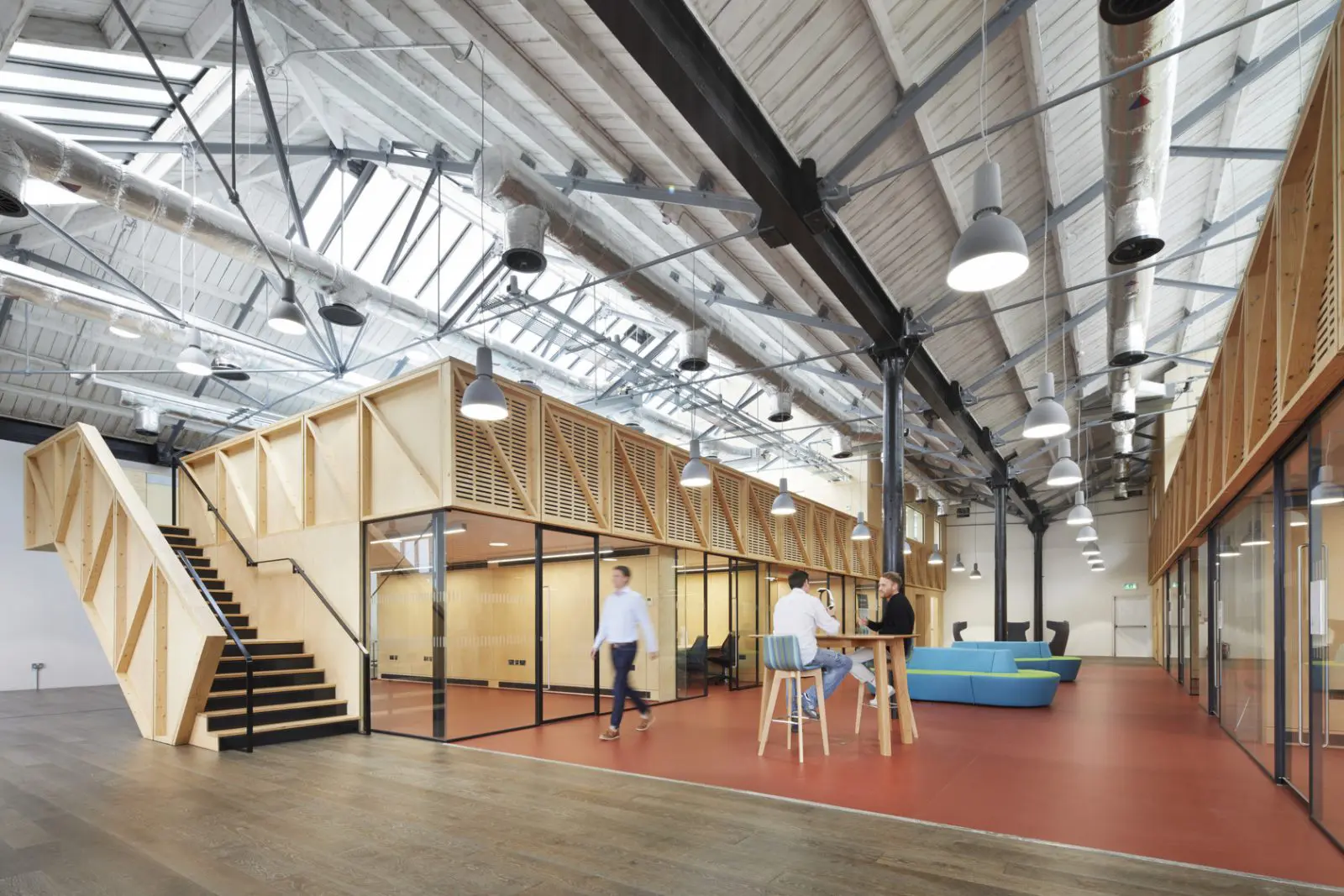
At Carriage Works, that relationship between heritage and innovation sits at the heart of the site’s identity.
Rooted within the former Great Western Railway works, the development carries the physical legacy of one of Britain’s great industrial stories. But its future is not about nostalgia. It is about reinvention.
Today, the site is evolving into a destination for creators, innovators, educators and ambitious businesses looking for something beyond anonymous office space.
Not every business wants polished corporate uniformity.
Increasingly, many want the opposite.
They want places with texture. Places with story. Places that reflect the kind of thinking they aspire to produce.
Modern innovation also increasingly happens across disciplines. A software developer may collaborate with a sustainability consultant. A production company may work alongside an education provider. A life sciences business may benefit from proximity to digital specialists, researchers or emerging technology partners.
That convergence is becoming one of the defining characteristics of modern regional innovation.
Innovation No Longer Lives in Silos
One of the most important shifts happening across the UK economy is the collapse of traditional sector boundaries.
Technology now intersects with almost everything. Life sciences businesses rely heavily on data, software and digital infrastructure. Sustainability ventures collaborate with researchers, educators and engineering specialists. Creative studios increasingly support scientific communication, public engagement and brand storytelling for complex industries.
Innovation no longer happens neatly within isolated sectors.
It happens between them.
That creates growing opportunities for places capable of supporting cross-disciplinary interaction rather than siloed industries operating independently.
Increasingly, progress comes from proximity between different types of thinkers, founders and specialists.
A researcher may collaborate with a digital developer. A creative business may support a technology startup. An education provider may work alongside sustainability or life sciences organisations.
These interactions are difficult to manufacture artificially. They emerge more naturally within environments designed around openness, flexibility and shared momentum.
That is why regional innovation ecosystems are becoming increasingly valuable.
Not simply because they provide workspace, but because they create environments where ideas can move more freely between sectors.
Why Regional Ecosystems Matter
Modern companies rarely operate entirely independently anymore.
Businesses collaborate constantly with freelancers, consultants, researchers, universities, software specialists, production teams, creative partners and technology providers. Innovation increasingly happens at the edges between industries rather than solely within them.
That makes proximity valuable again.
Not necessarily in the traditional sense of giant financial districts, but within smaller, more connected ecosystems where collaboration feels natural rather than forced.
Coworking environments, flexible studios and mixed-use innovation spaces are becoming increasingly important because they encourage accidental interaction. Conversations happen between meetings. Ideas spread organically. Relationships develop over time.
This is particularly valuable for startups and scaling businesses.
Founders often talk about how isolating early growth can feel. Access to a wider network of ambitious people facing similar challenges creates momentum that cannot easily be replicated remotely.
At Carriage Works, spaces such as Workshed have helped establish that kind of environment, bringing together businesses across technology, life sciences, sustainability, education, digital and creative sectors within a shared setting designed around flexibility and collaboration.
That matters because regional innovation is rarely driven by a single large corporation anymore.
It is increasingly powered by networks of smaller ambitious businesses building alongside one another.
The Cost of Staying Still
There is another reason regional innovation is accelerating.
Economics.
For many businesses, particularly SMEs and scaling companies, traditional city-centre operating models have become increasingly difficult to justify. Rising rents, recruitment pressures, commuting fatigue and operational overheads have forced companies to reassess what they actually need from a workspace.
The old equation is beginning to break down.
If teams are hybrid. If meetings are digital. If recruitment is flexible. If clients are distributed nationally. Then businesses are increasingly asking why they should absorb premium costs purely for location prestige.
That does not mean physical workplaces are disappearing.
Far from it.
It means businesses are becoming more selective about what physical space must deliver.
The expectation is no longer simply desks and Wi-Fi.
Businesses want environments that help attract talent. Support culture. Encourage creativity. Build identity. Enable collaboration. Create community. Support growth.
In many cases, regional innovation hubs are now better positioned to provide that combination than traditional city-centre offices.
A New Era for Places Like Swindon
For years, regional towns often found themselves defined by what they lacked rather than what they offered.
But that narrative is changing.
Places like Swindon increasingly occupy an important position within Britain’s economic future. Connected but affordable. Established but evolving. Large enough to sustain innovation ecosystems, but agile enough to remain adaptable.
The growth of regional innovation economies is not accidental.
It reflects broader changes in how people want to live and work.
Businesses are becoming less interested in status and more interested in substance.
People are becoming less willing to trade wellbeing for proximity.
And younger companies are building with entirely different assumptions about geography than previous generations.
The result is a more distributed form of innovation emerging across the country.
Not concentrated within a single city. Not dependent on a single postcode. But connected through networks of ambitious people choosing environments that support the way they actually want to work.
The Future Belongs to Adaptable Places
The businesses succeeding today are often the ones willing to challenge old assumptions about growth, talent, collaboration and geography.
The places succeeding alongside them are doing the same.
Historic buildings are becoming innovation hubs. Regional towns are attracting ambitious startups. Flexible workspaces are replacing rigid office models. Cross-sector collaboration is becoming more fluid. Business communities are becoming more interconnected.
The old hierarchy between “regional” and “major city” is beginning to lose relevance.
What matters now is whether a place creates the right conditions for ideas, people and businesses to thrive.
That is the real opportunity for developments like Carriage Works.
Not simply providing workspace, but helping shape the environments where the next generation of regional innovators, across technology, life sciences, sustainability, education and creative industries, can build what comes next.
Contact
Be part of what’s next.
Ready to join the Carriage Works community?
call: 07989 390005
Email: hello@carriageworks.co.uk
Thank you! Your submission has been received!