Swindon is the Place to Do Business
Swindon's Quiet Renaissance: Why Britain's Most Compelling Investment Story Might Be Happening Here
Swindon has rarely sought the limelight. Yet while attention has focused on Britain's larger cities, the town has quietly built one of the country's most resilient and diverse economies. As investment gathers pace and confidence grows, a new chapter is emerging, one in which heritage, innovation and enterprise are combining to redefine what Swindon represents.
Every town has a story it tells the outside world. Some spend years trying to reinvent themselves, commissioning new branding campaigns or ambitious masterplans designed to alter long-held perceptions. Others find that their reputation evolves naturally because the evidence becomes impossible to ignore. Swindon has never been particularly interested in selling itself, yet it is increasingly becoming one of those places whose economic reality is beginning to outpace its public image.
For decades, the town has lived in the shadow of assumptions that fail to reflect the place it has become. Mention Swindon to someone who has never spent time here and they are just as likely to reference a famous roundabout or a passing motorway junction as they are the thriving business community that has developed over generations. Yet look beyond the stereotypes and a very different picture emerges. This is a town that has quietly become one of Britain's most successful locations for business investment, home to global employers, pioneering manufacturers, ambitious technology companies and an increasingly confident creative sector.
What makes Swindon particularly interesting is that its success has rarely depended upon moments of dramatic transformation. There has been no single event that changed the town's fortunes overnight, nor one flagship development that suddenly altered its trajectory. Instead, progress has been built steadily over many decades through a combination of strategic location, skilled people, commercial pragmatism and a remarkable ability to adapt as industries have evolved. It is perhaps this understated confidence that has allowed Swindon to continue growing while others have spent years talking about what growth might look like.
That ability to evolve has always been central to the town's identity. Swindon was never destined to remain a quiet Wiltshire market settlement. Everything changed when Isambard Kingdom Brunel selected the site for the Great Western Railway Works in the 1840s. Within a generation, Swindon had become one of the most important centres of engineering in Britain. Thousands of highly skilled workers arrived to build and maintain locomotives that connected towns and cities across the country, creating not only jobs but a culture of technical excellence that would define the town for more than a century.
Those workshops did far more than manufacture engines. They produced generations of engineers, innovators and problem solvers. Skills were passed from one generation to the next, creating a workforce whose reputation extended well beyond Wiltshire. Long before phrases such as "knowledge economy" entered everyday language, Swindon had already established itself as a place where expertise, precision and innovation mattered.
Although the railway era eventually came to an end, the qualities that attracted Brunel never disappeared. Swindon's location remained exceptional, sitting at the heart of the M4 corridor with easy access to London, Bristol, South Wales, Oxford and the Midlands. The workforce remained adaptable, while commercial land continued to offer value compared with many neighbouring centres. As Britain's economy changed, so too did Swindon's industrial landscape.
International companies quickly recognised the opportunity.
Over the following decades the town became home to organisations including Honda, Intel, Nationwide Building Society, Zurich, Catalent, WH Smith, Amazon and many others, each attracted by a combination of geography, talent and infrastructure that remains difficult to replicate elsewhere. While individual companies have come and gone, the underlying conditions that made Swindon attractive have remained remarkably consistent. Businesses could recruit skilled people, move goods efficiently, reach customers quickly and operate at costs considerably lower than many competing locations.
That continuity is often overlooked. Discussions about economic change frequently focus on the departure of large employers while paying less attention to the investment that follows. Honda's decision to cease manufacturing in Swindon understandably dominated headlines, yet the story did not end with the closure of the factory gates. In many ways it marked the beginning of another chapter.
Today, the former Honda site is being transformed into Panattoni Park Swindon, one of the largest regeneration and logistics developments in Europe. Representing an investment measured in hundreds of millions of pounds, the scheme will deliver millions of square feet of high-quality industrial and logistics space while creating thousands of jobs over the coming years. It is a powerful illustration of Swindon's ability to reinvent itself, repurposing one of Britain's most recognisable manufacturing sites to meet the demands of a changing economy rather than allowing it to become a monument to industrial decline.
The redevelopment also reflects broader shifts in how businesses operate. Manufacturing remains vital to Britain's economy, but logistics, advanced distribution, automation and supply chain management have become equally important components of modern commerce. Swindon's position, once valued for moving locomotives and later motor vehicles, is now perfectly suited to supporting national distribution networks serving every corner of the country.
Yet to view Swindon purely through the lens of logistics or manufacturing would be to miss one of its most significant strengths. Perhaps the defining characteristic of the modern local economy is its diversity.
Few towns of comparable size can point to such a broad mix of industries. Advanced engineering sits alongside financial services. Global manufacturers share the landscape with digital agencies, software developers, creative consultancies, cybersecurity specialists and education providers. Professional services, life sciences, defence technology and specialist engineering firms all contribute to an economy that has become remarkably balanced.
That diversity provides resilience.
Communities that depend heavily upon one employer or one dominant sector are often vulnerable when markets change. Swindon's economy, by contrast, benefits from a constant interplay between different industries, allowing knowledge, talent and opportunity to move more freely across sectors. Designers collaborate with engineers. Creative agencies work with technology companies. Software developers support manufacturers. Universities and educational institutions increasingly work alongside employers to develop the skills that tomorrow's economy will require.
The result is an ecosystem that feels increasingly connected rather than fragmented.
It is no coincidence that specialist business communities have begun to flourish across the town. Over recent years Swindon has seen growing momentum around cybersecurity, artificial intelligence, digital technology and entrepreneurship, with new events and professional networks providing opportunities for collaboration that once required travelling to Bristol, Reading or London. Increasingly, those conversations are happening locally, strengthening relationships between businesses while helping to retain talent that may previously have looked elsewhere.
The creative industries have also played an important role in that evolution. Design, branding, marketing, digital content, architecture and media businesses have become an increasingly visible part of Swindon's commercial landscape, reflecting a wider recognition that creativity is no longer separate from economic growth but fundamental to it. Today's manufacturers require digital experiences. Technology companies need compelling brands. Educational organisations compete for attention in increasingly crowded markets. Creativity has become an economic asset rather than simply a cultural one.
This changing economy is supported by a growing sense of civic ambition. Swindon Borough Council's Economic Growth Plan sets out a long-term vision centred on innovation, productivity, sustainability and inward investment, recognising that future prosperity will depend not only on attracting businesses but on creating places where talented people choose to build careers and establish companies. Alongside wider regeneration programmes across the town centre, investment is increasingly focused on improving the quality of the places in which people work, collaborate and spend their time.
That shift reflects a wider change in how businesses make decisions about location. Competitive rents and excellent transport links remain important, but they are no longer sufficient on their own. Companies increasingly seek environments that help attract and retain talented people. They look for character, quality, connectivity and opportunities for collaboration. They understand that place has become a competitive advantage.
Few projects illustrate that thinking better than the continuing evolution of the Carriage Works.
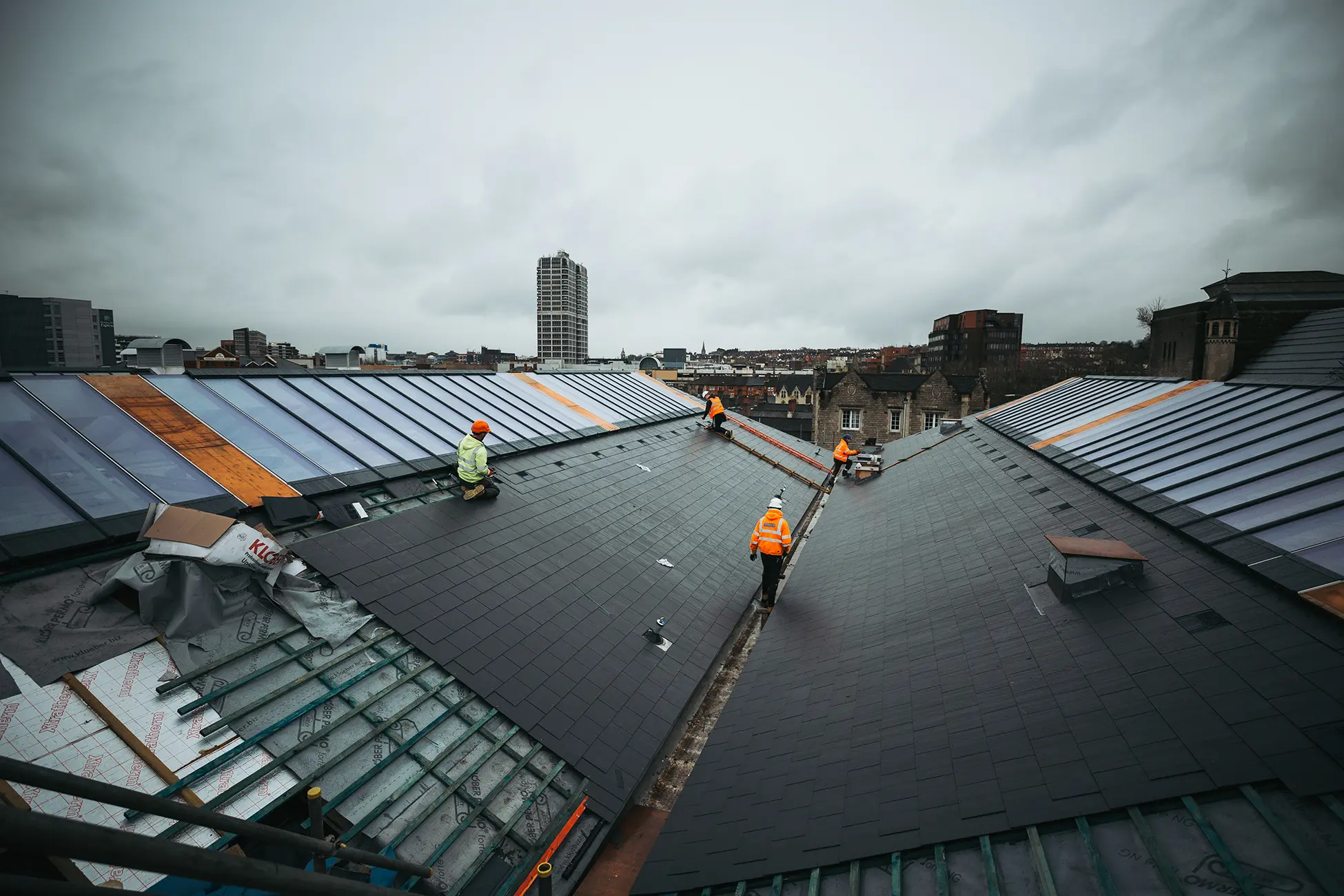
The Carriage Works occupies a unique position within this wider story. It is easy to see the restoration of these Grade II listed buildings simply as another regeneration project, but that would underestimate their significance. The development is not attempting to recreate Swindon's past as a museum piece, nor is it erasing its industrial heritage in pursuit of something entirely new. Instead, it demonstrates how historic places can be adapted to serve contemporary economic needs while retaining the character that makes them distinctive.
There is a certain symmetry in that ambition. For more than a century these workshops were places where skilled people came together to solve problems, build products and exchange knowledge. Today's occupants may be developing software rather than steam engines, creating brands rather than boilers or designing digital experiences instead of mechanical components, but the underlying principle remains remarkably similar. The Carriage Works continues the tradition of bringing talented people together in an environment designed to encourage productivity, collaboration and enterprise.
Increasingly, this is what successful workplaces look like. Businesses no longer judge premises solely by square footage or rental costs. They are looking for environments that help them recruit talented people, encourage collaboration and reflect their own identity. Character has become an economic asset. Heritage buildings, thoughtfully restored and equipped for modern business, offer something that anonymous office parks cannot. They create a sense of place, and that sense of place has become an increasingly important factor in where ambitious businesses choose to locate.
The success of the Workshed has already demonstrated the appetite for this approach. Since opening, it has become home to a diverse community of entrepreneurs, freelancers, creative businesses and growing companies that value collaboration as much as convenience. The conversations taking place within its walls have generated new partnerships, new businesses and new opportunities, proving that economic growth is often driven not only by investment in buildings but by investment in communities.
The Carriage Works represents the natural progression of that idea. It provides room for businesses that have outgrown coworking, organisations seeking permanent offices and companies that want to establish themselves within one of the most distinctive commercial environments in the region. Together, the Workshed and the Carriage Works create a continuum that allows businesses to start, scale and remain in Swindon rather than looking elsewhere as they grow.
This matters because successful economies are rarely built by attracting one large employer at a time. They are built by creating conditions in which hundreds of businesses can succeed simultaneously. Every new startup that survives, every growing SME that recruits additional staff and every established company that chooses to remain in Swindon contributes to a stronger local economy. Collectively, those decisions create momentum that becomes increasingly difficult to ignore.
Momentum is perhaps the defining feature of Swindon's current position. While some towns continue to debate how best to regenerate their centres or attract inward investment, Swindon is already seeing tangible progress. Major commercial developments continue to move forward. The town's strategic location remains one of its greatest competitive advantages. Business confidence has remained resilient despite wider economic uncertainty, while investment in commercial property, infrastructure and public spaces continues to reshape perceptions of what the town can offer.
Importantly, this momentum extends beyond physical development. There is a growing confidence among the people building businesses here, a belief that Swindon no longer needs to compare itself with neighbouring cities in order to define its own success. For too long the town has found itself measured against Bristol, Reading or Oxford, as though proximity to larger centres somehow diminished its own achievements. Increasingly, that comparison feels outdated.
Swindon's competitive advantage has never been that it is trying to become Bristol or Reading. Its strength lies in being something different. It combines excellent connectivity with comparatively affordable commercial space, a highly skilled workforce, strong educational links and a business community that remains accessible. Decision-makers are easier to reach, partnerships often develop more quickly and organisations are able to become part of a genuinely connected business network rather than simply another name on a city directory.
This is particularly important for small and medium-sized enterprises, which remain the backbone of the British economy. Large corporations may attract headlines, but it is SMEs that create the majority of private sector employment and drive much of the country's innovation. Swindon has become an increasingly attractive environment for those businesses because it offers something that many larger cities struggle to provide: room to grow without sacrificing connectivity or opportunity.
The changing nature of work has reinforced that advantage. Hybrid working has encouraged businesses to think differently about location, with many organisations recognising that proximity to London no longer requires a London postcode. Fast rail connections place Paddington within easy reach, while the M4 corridor provides access to some of the UK's strongest regional economies. Businesses can recruit nationally while offering employees a quality of life that is increasingly difficult to achieve in larger urban centres.
Quality of place has become inseparable from economic performance. People increasingly choose employers based not only on salary, but on lifestyle, wellbeing and the environments in which they spend their time. Companies understand this. Investors understand it too. Places that combine commercial opportunity with character, culture and connectivity are becoming some of the most attractive destinations for long-term investment.
Swindon is steadily assembling those qualities.
The town's industrial heritage provides authenticity rather than nostalgia. Its modern economy is broad enough to withstand changing markets while creating opportunities across multiple sectors. Significant investment continues to reshape key sites, while independent businesses, educational institutions and established employers are contributing to an increasingly confident local ecosystem. None of these developments alone would justify describing Swindon as one of Britain's most interesting business locations. Together, however, they tell a compelling story of sustained progress.
Perhaps the most encouraging aspect of that story is that it remains unfinished.
Across the town there are opportunities still to be realised. New businesses will emerge. Existing companies will continue to expand. Regeneration projects will mature, bringing more people into the town centre and creating stronger links between commerce, culture and community. The next generation of entrepreneurs will establish businesses that cannot yet be imagined, just as previous generations built industries that transformed the town beyond recognition.
The Carriage Works has an important role to play in that future. Not because it alone will redefine Swindon, but because it embodies the qualities that have always underpinned the town's success: adaptability, craftsmanship, enterprise and a willingness to embrace change without forgetting where it came from.
There is a temptation when writing about regeneration to focus solely on buildings. New offices, restored facades and public realm improvements are tangible, easily photographed and simple to explain. Yet successful regeneration has never really been about bricks and mortar. It is about creating places where people want to build businesses, pursue careers, exchange ideas and invest their futures. Buildings simply provide the stage upon which those ambitions can unfold.
That is ultimately what makes the Carriage Works significant. It is not simply preserving an important part of Swindon's history; it is ensuring that history continues to contribute to the town's future. The same spirit of ingenuity that once made these workshops one of Britain's greatest centres of engineering is now helping to support a new generation of designers, technologists, educators, entrepreneurs and innovators.
For a town that has spent much of its history making things, that feels entirely appropriate.
Swindon has never relied on grand declarations or carefully constructed narratives to define its success. Its reputation has always been built through the achievements of the people and businesses that choose to make their future here. Today, as investment gathers pace and confidence continues to grow, that tradition shows no sign of changing.
The town's next chapter is already being written. The Carriage Works is one of the places where it is happening.
If you are looking for an office space that helps your team thrive, get in touch to book a viewing. Come and see how Carriage Works can work for you.
Contact
Be part of what’s next.
Ready to join the Carriage Works community?
call: 07989 390005
Email: hello@carriageworks.co.uk
Thank you! Your submission has been received!